Yeonsu Kwak
Ph.D., Chemical & Biomolecular Engineering, University of Delaware

I develop electrified reactors using microwave and Joule heating, with operando measurements of catalyst behavior. My research focuses on hydrogen carriers and the conversion of biomass, shale gas, and biogas into fuels and value-added chemicals.
Advised by Prof. Dionisios G. Vlachos, I defended my Ph.D. in November 2026. I will join the National Laboratory of the Rockies as a postdoctoral researcher with Dr. Gregg Beckham in late 2026. Read my CV:
Design
the
Reaction
Environment.
Spatial control | Microwave heating
Microwave-heated PtSn/SiO₂ sustained propane dehydrogenation without H₂ co-feed. Coking and sintering were lower than under furnace heating. Science Advances, 2023
Microwave heating
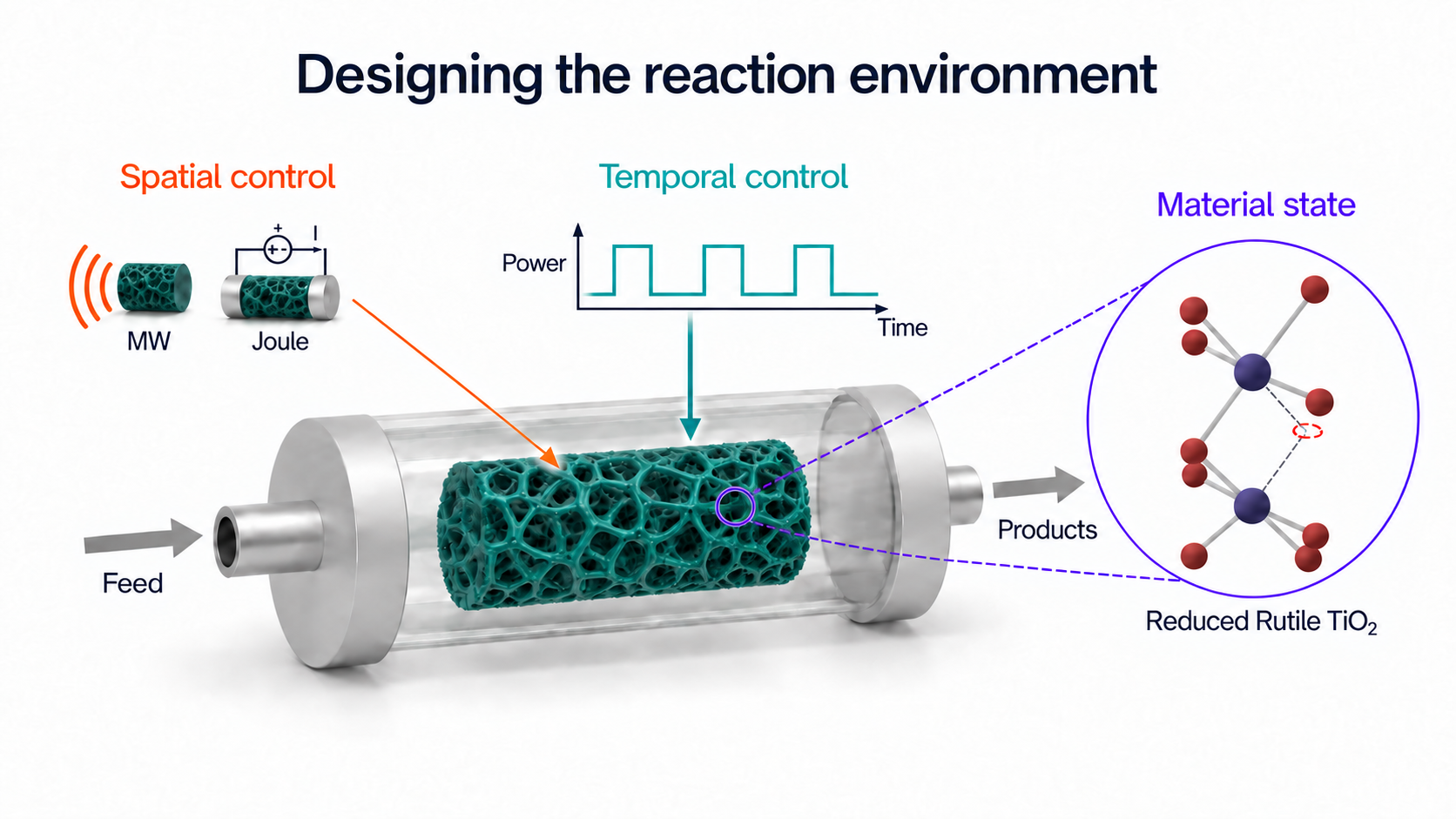
Microwave heating changes where energy is deposited in a catalytic reactor. I study how this affects temperature distributions, catalyst stability and reaction performance.
Joule heating
Joule heating enables rapid and programmable reactor temperatures. I use continuous and pulsed operation to control heat transfer, reaction time and carbon formation.
Operando characterization
Electromagnetic fields can change catalyst temperature, oxidation state and structure during reaction. Dielectric, Raman and X-ray measurements help identify which change produces the observed performance.
Hydrogen reactor development
Hydrogen-carrier processes must combine catalyst activity with effective heat management and scalable reactor design. My work covers this path from catalyst screening to pilot-scale operation.
SAF process scale-up
Converting triglycerides into sustainable aviation fuel requires hydrotreating, hydrocracking and distillation to meet ASTM D7566 specifications. I helped develop and operate a 5 ton/yr pilot plant.
Process modeling and TEA
Kinetic, transport and process models connect laboratory measurements to reactor design, energy use and cost. I develop these models alongside experiments and release selected design tools openly.
The papers behind each direction are on the publications page.